


 +44 121 753 0077
Industrial drum heaters are commonly used to warm temperature-sensitive materials, maintain viscosity and make liquids easier to transfer or process. However, heating a drum to the required temperature can sometimes take considerably longer than expected, particularly when working with thick liquids, resins, adhesives and other viscous materials.
A slow heating process doesn’t necessarily mean the drum heater is faulty. Heating time is influenced by several factors, including the volume and properties of the contents, the heater’s output, the drum’s construction and the surrounding environment.
Understanding how these factors affect heat transfer can help industrial operators identify potential problems, improve heating efficiency and maintain suitable temperatures without exposing materials to excessive heat.
Why Does Drum Heating Time Vary?
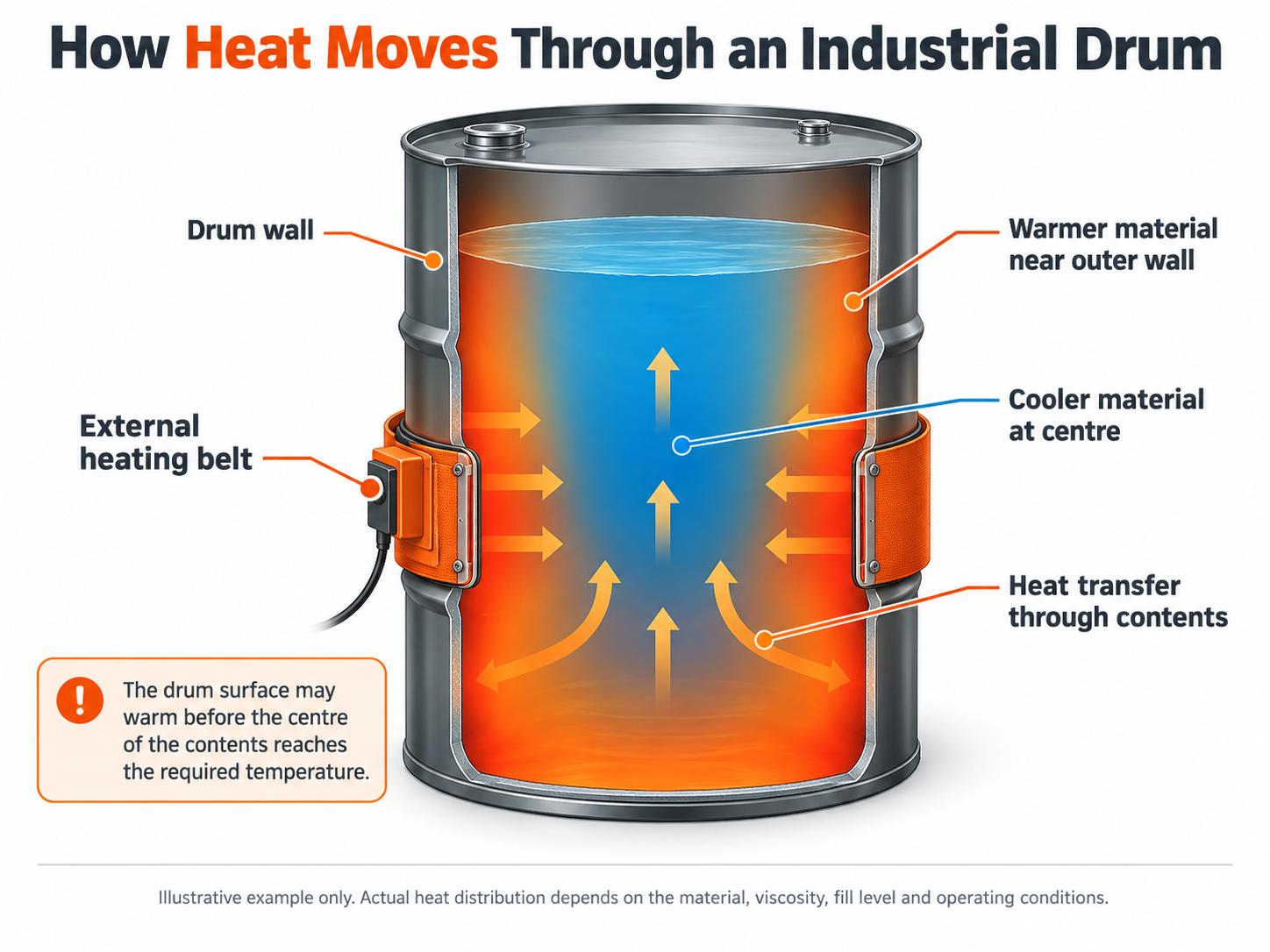
An electric drum heater transfers heat through the container wall and into the material inside. While the outside of the drum may warm relatively quickly, it can take significantly longer for that heat to reach the centre of the contents.
The amount of energy required depends on the mass of material being heated, its specific heat capacity and the temperature increase needed. Heat is also continually lost to the surrounding environment, particularly where drums are stored in cold or poorly insulated areas.
The material itself makes a considerable difference. Some liquids distribute heat relatively effectively through natural circulation, while thicker or partially solidified products may warm much more slowly.
It’s also important to distinguish between two heating requirements:
- Temperature Maintenance: Keeping material at an existing operating temperature by compensating for heat loss.
- Initial Heating: Raising colder material to a higher temperature, which requires additional energy and potentially a longer heating period.
A heater that performs well for temperature maintenance may not necessarily provide the heat-up time required for a particular production schedule.
Seven Factors That Can Slow Down Industrial Drum Heating
1. The Volume and Starting Temperature of the Contents
One of the most important factors affecting drum heating time is the amount of material being heated.
A nearly full 200-litre drum generally requires more energy to achieve the same temperature increase than a smaller quantity of the same material. Similarly, a drum stored overnight in a cold warehouse will usually take longer to reach its required temperature than one starting closer to the target.
The difference between the starting and target temperatures is particularly important. Raising a material by a few degrees for viscosity control is a very different requirement from warming a large volume of cold material before processing.
When assessing heating performance, record both the initial temperature and the required operating temperature rather than relying solely on the heater’s temperature setting.
2. High Viscosity and Poor Heat Distribution
Viscous materials such as adhesives, resins, waxes and heavy oils can be particularly challenging to heat consistently.
As an external heater warms the drum wall, the material nearest that surface receives heat first. In less viscous liquids, natural convection can help circulate warmer material through the container.
However, highly viscous or partially solidified materials may have limited internal movement. Heat then travels more slowly towards the centre, creating a temperature difference between the outer layers and the remaining contents.
This explains why a drum can feel warm externally while the material inside remains difficult to pump or dispense.
Where mixing or circulation is permitted by the material manufacturer and process design, it may help improve temperature uniformity. However, this should only be considered using equipment and procedures suitable for the substance being handled.
3. Insufficient Heating Output for the Required Heat-Up Time
The electrical heating output must be appropriate for the amount of material, required temperature increase and expected heating period.
A relatively low-output drum heating belt may be entirely suitable for frost protection or maintaining an existing temperature, but could take considerably longer to warm a large drum of cold material.
Heating output is usually expressed in watts. In general, greater effective heating power can reduce warming time, although the improvement also depends on heat transfer through the container and contents.
Increasing heating power isn’t always the answer. Concentrating excessive heat over a small area can create high surface temperatures without significantly improving heat distribution throughout the drum.
For temperature-sensitive materials, the heating arrangement must balance the required heating time with the maximum permissible temperatures of the container and its contents.
4. Poor Heater Contact or Incorrect Positioning
External drum heating belts rely on transferring heat through the container wall. If the heater doesn’t make suitable contact with the drum, some of its output may be lost rather than transferred efficiently into the contents.
Loose fitting, unsuitable belt dimensions, uneven container surfaces or incorrect installation can all affect heating performance.
Heater positioning is another important consideration, particularly where drums are only partially filled. The heating belt must be installed in accordance with the manufacturer’s instructions, including any requirements concerning the minimum contents level.
Heating an empty section of a drum can create a risk of local overheating because there may be insufficient material behind the heated surface to absorb the energy.
Check that the belt is correctly fitted, securely positioned and suitable for the specific container before investigating changes to the heating settings.
5. Heat Loss to the Surrounding Environment
The heater must supply enough energy to warm the contents while also compensating for heat escaping into the surrounding environment.
Drums stored in cold warehouses, exposed industrial areas or draughty locations may experience greater heat loss than those kept under controlled indoor conditions.
Heat can escape through the drum walls, lid and base, including through contact with cold floors or supporting structures.
Where appropriate for the application, suitable thermal insulation can reduce these losses and help more of the available heating energy contribute to warming the contents.
However, insulation should be compatible with the heater, container and operating conditions. Covering equipment with unsuitable materials can create overheating or electrical safety risks.
6. Drum Material and Construction
The construction of the container affects how heat moves from the external heater into its contents.
Metal drums generally conduct heat more readily than plastic containers, although the actual performance also depends on wall thickness, surface contact and the material being heated.
Plastic drums require additional care because their allowable operating temperatures and resistance to localised heating vary between materials and designs. Not every external drum heater is suitable for use on plastic containers.
Surface coatings, structural features and unusual container dimensions can also influence contact with the heating belt.
The drum manufacturer’s temperature limits and the heating equipment’s compatibility requirements should therefore be checked before use.
7. Temperature Control or Electrical Supply Problems
Sometimes, slow drum heating is caused by the way the heating system is controlled rather than by the material itself.
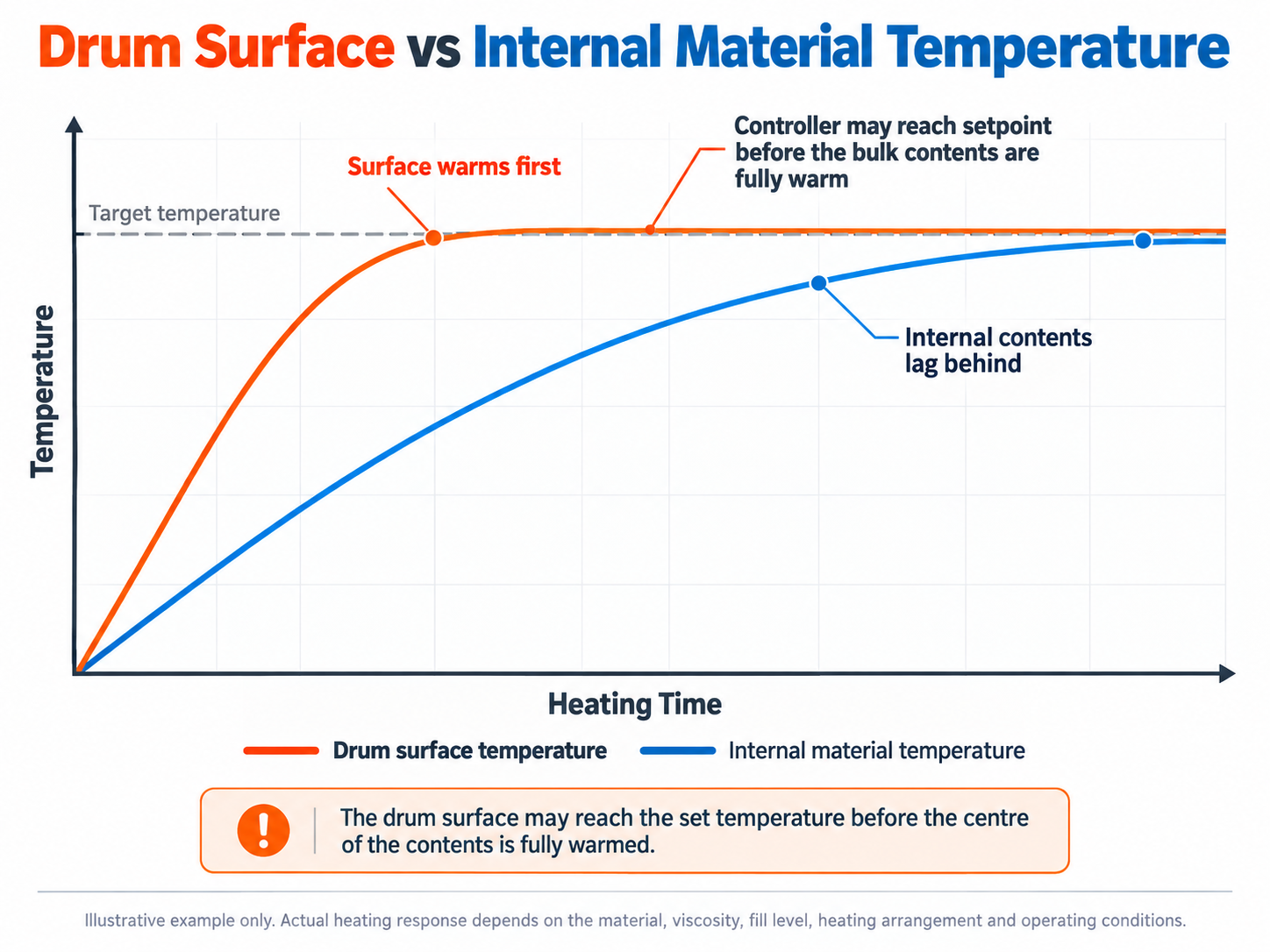
A temperature sensor positioned close to the heater may reach the selected temperature before the centre of the drum has warmed sufficiently. The controller may then reduce or interrupt heating, even though the bulk contents remain below the required process temperature.
Incorrect controller settings, faulty temperature sensors, damaged electrical connections or supply problems can also affect the heating output.
A controller displaying the desired temperature does not necessarily confirm that the entire drum has reached that temperature.
If the heating system appears to switch off prematurely or fails to maintain its expected performance, the control arrangement and electrical components should be assessed by appropriately qualified personnel.
How to Investigate a Drum That Is Heating Too Slowly
Before assuming the heater needs replacing, it’s worth reviewing the complete heating process.
The following checks can help identify potential causes:
- Confirm the Heating Requirement: Establish the material’s starting temperature, target temperature, volume and acceptable heating period.
- Check the Heater Installation: Inspect the fitting, positioning and condition of the belt against the manufacturer’s instructions.
- Review the Environment: Consider ambient temperatures, draughts, floor contact and heat loss from exposed parts of the drum.
- Assess Temperature Measurements: Check whether the measured temperature represents the heater, drum surface or actual contents.
- Review the Equipment Specification: Confirm that the heater’s rated output, control arrangement and container compatibility suit the application.
Where heating performance has changed unexpectedly, it is also worth checking maintenance records and any differences in the materials or operating conditions.
Do not increase the temperature setting or modify the electrical equipment simply to accelerate the process without confirming that doing so is safe.
How Long Should an Industrial Drum Take to Heat Up?
There is no single heating time that applies to every industrial drum.
Two containers of the same size can require significantly different heating periods depending on their contents, starting temperatures, heating arrangements and surrounding conditions.
For example, warming a free-flowing liquid by a small amount may be relatively straightforward, while raising the temperature of a full drum containing partially solidified wax or a highly viscous resin can take considerably longer.
For applications where heating time affects production schedules, the best approach is to establish the material’s requirements and assess the energy needed, heat losses and effectiveness of heat transfer through the container.
This allows a realistic heating period to be determined rather than relying on a general estimate that may not reflect the actual application.
When Is It Worth Reviewing Your Drum Heating Arrangement?
If a drum consistently takes longer than expected to reach its operating temperature, the current heating arrangement may not be ideally suited to the process.
The issue could involve insufficient heating coverage, excessive environmental losses, unsuitable temperature monitoring or a mismatch between the equipment and the material being heated.
Where production requirements have changed, an arrangement originally intended for temperature maintenance may also need reassessment if faster initial heating has become necessary.
Flexible Heated Hoses supplies standard and bespoke industrial drum heating belts, with options designed around individual container dimensions, electrical requirements and operating conditions.
For more information about the available products, visit our Drum Heaters page.
Frequently Asked Questions About Drum Heating Time
Why is my drum warm on the outside but cold in the middle?
External drum heaters apply heat through the container wall, so the material closest to that surface generally warms first. Thick or highly viscous contents may distribute heat slowly, leaving the centre significantly cooler. The difference depends on the material’s thermal properties, heating duration and whether internal circulation occurs.
Can increasing the temperature setting make a drum heat faster?
Increasing the temperature setting may allow a heater to operate for longer before reaching its control limit, but it doesn’t necessarily increase the heater’s rated power. Higher temperatures can also damage sensitive materials or exceed the container’s safe operating limits. The correct approach is to assess the heating requirements and equipment specification before changing settings.
Does a larger drum take longer to heat?
Generally, a larger quantity of the same material requires more energy to achieve an equivalent temperature increase. However, actual heating time also depends on the available heating output, drum construction, thermal losses and heat distribution. A larger container with appropriately designed heating may perform differently from a smaller drum using limited heating coverage.
Can insulation help reduce drum heating time?
Suitable thermal insulation can reduce heat loss from the drum, allowing more of the heater’s output to contribute to warming the contents. This may improve heating efficiency, particularly in colder environments. Any insulation must be approved for the heating arrangement and compatible with the operating temperature and container.
Why does a drum heater reach its set temperature before the contents are warm?
The sensor may be measuring the heater or drum surface rather than the temperature of the contents. These locations can warm at different rates, particularly when heating viscous liquids. Additional appropriate temperature measurements may be needed to establish whether the material itself has reached the required operating temperature.
Can drum heaters be used on partially filled containers?
This depends on the heater design, drum material and manufacturer’s instructions. Some heating bands must remain below the minimum contents level to prevent local overheating. Never assume that a heater suitable for a full drum is automatically suitable for the same container when partially filled.
Will mixing the contents help them heat more evenly?
Where permitted by the material manufacturer’s instructions and process requirements, suitable mixing or circulation can help distribute heat throughout the contents. However, not every material can be safely mixed or agitated, particularly where contamination, chemical reactions or hazardous conditions are concerns. The method should be assessed for the specific application.
What information is needed to assess a slow drum heating process?
Useful details include the drum capacity and construction, fill level, contents, starting temperature, target temperature and desired heat-up time. The heater’s rated power, operating voltage, controller arrangement and surrounding conditions are also important. Providing this information helps identify whether the issue relates to heat transfer, installation, controls or the equipment specification.
Need Help with Your Drum Heating Requirements?
Slow drum heating can affect production schedules, material handling and process efficiency, particularly where temperature-sensitive liquids must be ready for use at specific times.
Flexible Heated Hoses can discuss your existing heating arrangement and advise on standard or bespoke drum heating solutions suited to your application.
Contact our team to discuss your requirements or request a quotation.