


 +44 121 753 0077
Production shutdowns are a routine part of industrial operations, whether for scheduled maintenance, equipment servicing or temporary interruptions to manufacturing. However, when processes involve temperature-sensitive materials, even a relatively short period of inactivity can create additional challenges.
Substances such as adhesives, resins, waxes, oils and certain chemical products can behave differently as temperatures change. Some become increasingly viscous as they cool, while others may crystallise, solidify or undergo changes that affect their suitability for processing.
Understanding these effects is important when planning shutdown procedures, protecting equipment and preparing production lines for a reliable restart.
Why Temperature Control Matters During Production Shutdowns
During normal operation, industrial processes often rely on heating equipment to maintain materials within a suitable temperature range. This helps ensure consistent viscosity, reliable fluid transfer and appropriate conditions for manufacturing or processing.
When production stops, fluid circulation may cease and the heating requirements can change significantly. Material remaining inside tanks, drums, pipework and transfer hoses may gradually lose heat, particularly if the heating system is switched off.
The rate of cooling depends on several factors, including the material’s properties, the surrounding temperature, insulation and the volume of material involved.
A production shutdown does not necessarily mean that all heating equipment should remain operational. Some materials require continued temperature maintenance, while others benefit from controlled cooling or complete system shutdown.
The appropriate approach depends on the material manufacturer’s recommendations, the expected shutdown duration and the operating requirements of the equipment.
What Can Happen to Materials When Production Stops?
Different temperature-sensitive materials respond to cooling and prolonged heating in different ways. The following are some of the most important considerations for industrial processes.
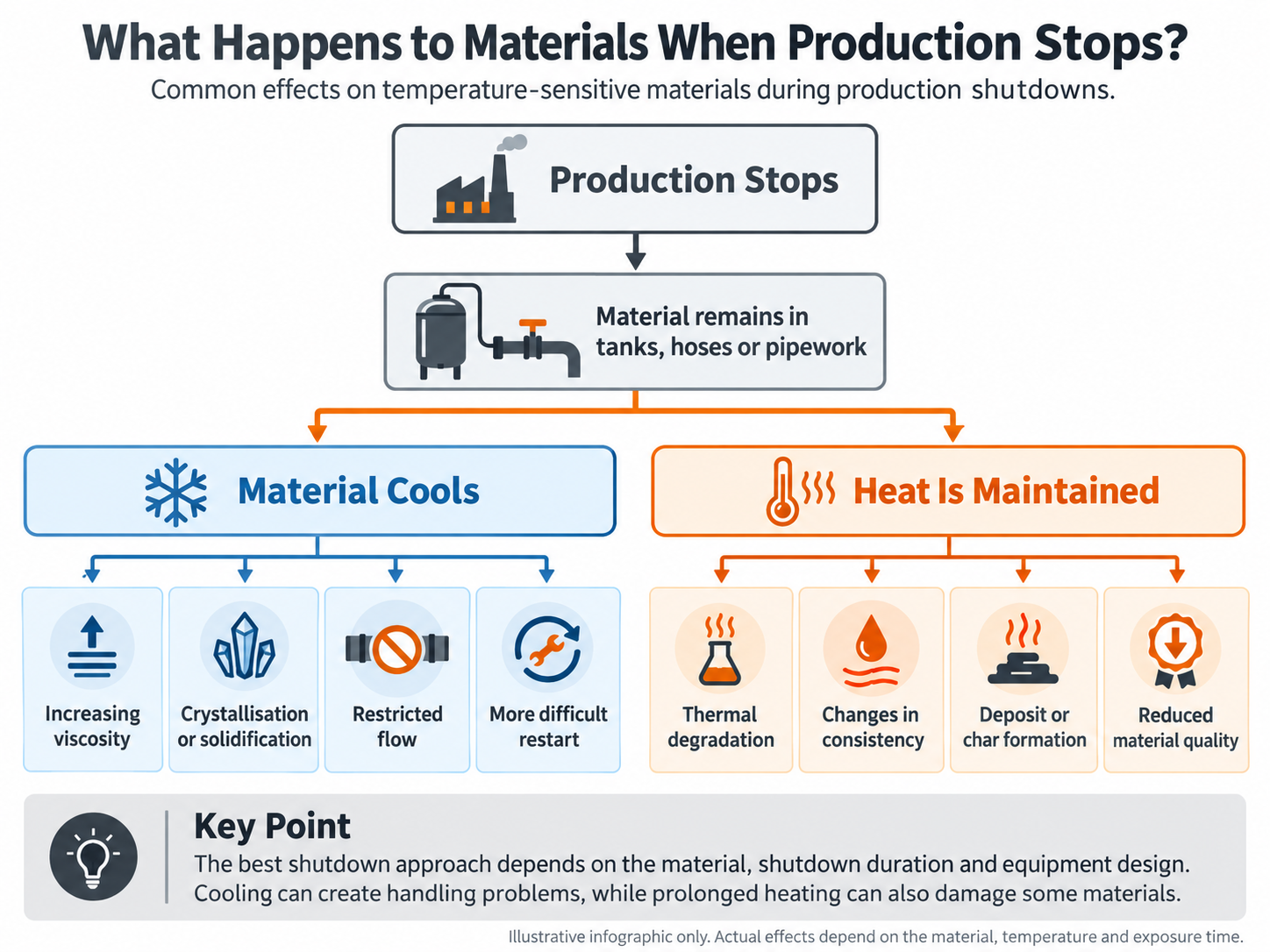
1. Increased Viscosity and Reduced Flow
One of the most common consequences of falling temperatures is an increase in material viscosity.
Many industrial liquids become thicker as they cool, making them more difficult to pump, transfer or dispense. This can be particularly noticeable with certain oils, adhesives, resins and other materials that require controlled temperatures for efficient handling.
If viscosity increases significantly, pumping equipment may need to work harder to maintain the required flow rate. In some applications, the material may become too thick to move effectively through the existing system.
When production resumes, additional warming may be necessary before normal fluid transfer can take place.
2. Material Solidification or Crystallisation
Certain materials may begin to solidify or form crystals when their temperature falls below a particular threshold.
Waxes and some hot-melt materials, for example, are processed in a heated state and may become solid when cooled. Other substances can develop crystalline deposits or partially solidified sections depending on their chemical composition.
This can create problems where material remains inside narrow pipework, valves, filters and dispensing equipment.
Importantly, solidification is not always permanent or damaging. Some materials can be reheated and returned to a usable condition, while others may undergo changes that require more careful assessment.
Whether reheating is appropriate depends on the particular substance and its recommended handling procedures.
3. Temperature Differences Across the System
Industrial equipment does not necessarily cool at a uniform rate during a shutdown.
Large storage vessels may retain heat for longer than smaller pipework sections, while exposed valves, connections and transfer hoses may lose temperature more rapidly.
This can result in different parts of the same process containing material at noticeably different temperatures.
For example, material inside a well-insulated storage tank may remain sufficiently warm, while material left in an exposed transfer line becomes more viscous or begins to solidify.
Such differences can complicate restarting the system, particularly when the process requires consistent material temperatures throughout the transfer route.
4. Changes in Material Stability or Quality
Temperature changes can affect more than a material’s ability to flow.
Some products are sensitive to repeated heating and cooling, prolonged exposure to elevated temperatures or unsuitable storage conditions. Depending on their composition, these conditions may contribute to changes in consistency, separation, crystallisation or chemical stability.
Certain reactive resins and adhesives may also continue undergoing chemical changes independently of whether production equipment is operating. Once a material has cured or undergone irreversible degradation, simply reheating it will not restore its original properties.
This is why it is important to distinguish between materials that can safely be cooled and reheated and those that require more tightly controlled handling procedures.
5. Thermal Degradation from Prolonged Heating
Although cooling can create operational difficulties, maintaining excessive temperatures during an extended shutdown can also cause problems.
Some materials, particularly certain hot-melt adhesives, can deteriorate when exposed to elevated temperatures for prolonged periods.
This may contribute to changes in viscosity, discolouration, gelling or the formation of hardened deposits known as char.
These deposits can accumulate within tanks, hoses, filters and dispensing equipment, potentially affecting product quality and creating blockages.
Where supported by the material and equipment manufacturer, a reduced-temperature standby mode may help limit unnecessary heat exposure during periods of inactivity.
How Shutdown Duration Affects Temperature-Sensitive Materials
The length of a production shutdown can influence how much preparation and temperature management is required.
A short interruption may have little effect on materials stored inside well-insulated equipment. However, a longer shutdown could allow the same materials to cool considerably, depending on environmental conditions and the heating arrangement.
Similarly, some materials tolerate limited periods at their operating temperature but may deteriorate if they remain heated unnecessarily for extended periods.
| Shutdown Scenario | Main Considerations |
|---|---|
| Short Production Pause | Whether material temperatures remain within acceptable limits and whether standby settings are appropriate. |
| Overnight Shutdown | Cooling of stationary materials, heat loss from transfer lines and restart requirements. |
| Weekend or Extended Shutdown | Material stability, possible solidification, draining or purging requirements and heating controls. |
| Unplanned Equipment Shutdown | Unknown material temperatures, potential blockages and the need to assess equipment before restarting. |
These are general considerations rather than fixed operating rules. Shutdown procedures should reflect the actual material, equipment and process requirements.
How Can Production Shutdown Risks Be Reduced?
Effective shutdown planning begins with understanding which materials and equipment are most sensitive to temperature changes.
Rather than applying the same procedure to every process, operators should assess the requirements of the materials being handled and the conditions they are likely to experience during inactivity.
Review Material Temperature Requirements
Before a shutdown, establish the acceptable storage, handling and operating temperatures for each relevant material.
Manufacturer technical data sheets, safety information and established process procedures can help identify temperature limits, potential stability concerns and whether the material can safely remain within the equipment.
This information should guide decisions about continued heating, reduced-temperature operation, cooling, draining or other shutdown arrangements.
Identify Equipment That May Cool More Quickly
Consider the complete material transfer system, including tanks, drums, pipework, hoses, valves and dispensing equipment.
Smaller or poorly insulated components may lose heat more quickly than the main storage vessel, creating different temperatures throughout the installation.
Identifying these vulnerable areas can help determine where temperature maintenance, insulation or additional monitoring may be necessary.
Assess Whether Temperature Maintenance Is Required
Some materials must remain above a specified temperature to prevent unacceptable thickening or solidification.
For pipework applications, appropriately specified trace heating systems can help maintain temperatures and reduce the risk of materials cooling excessively during periods of inactivity.
Where this is the case, an appropriately designed temperature maintenance system may be necessary during certain production shutdowns.
For other applications, lowering the temperature or safely switching off the heating equipment may be more appropriate.
Any arrangement that remains energised during downtime must be specifically designed and authorised for that operating condition, particularly where maintenance personnel may be working on the equipment.
Consider Draining or Purging Requirements
For some processes, removing material from transfer lines before an extended shutdown can help reduce the risk of deposits or blockages developing during inactivity.
However, draining or purging is not appropriate for every material or installation. Certain substances may introduce additional chemical, pressure or contamination hazards if handled incorrectly.
These operations should only be carried out using established procedures suitable for the material and equipment.
Plan for Restarting the Process
Shutdown planning should also consider how the process will return to normal operation.
If material is expected to cool significantly, additional time may be needed to restore suitable processing temperatures before circulation or production can resume.
The required restart conditions should be established before the shutdown, helping to avoid unnecessary delays or inappropriate attempts to accelerate heating.
What Should Be Checked Before Restarting Production?
Restarting equipment after a shutdown requires more than simply switching the heating system back on.
Where temperature-sensitive materials are involved, several checks may be necessary to confirm that the process can resume safely and reliably.
1. Check Material Condition
Confirm that the material remains suitable for use and has not experienced unacceptable solidification, separation, contamination or degradation.
2. Verify Temperature Readings
Review relevant process temperatures and confirm that measurements represent the areas or materials that matter to the operation. A warm pipe surface does not necessarily mean the contents have reached the required temperature.
3. Inspect the Transfer Route
Check for potential restrictions, leaks, damaged equipment or other problems that may have developed during the shutdown.
4. Review Heating and Control Equipment
Ensure the required heating circuits, temperature sensors and controllers are operating correctly, using the manufacturer’s recommended checks and appropriately qualified personnel.
5. Follow the Approved Restart Procedure
Allow sufficient time for suitable temperatures to be established before resuming material transfer. Never attempt to force flow through suspected solidified blockages or increase heating beyond approved limits.
Where pipework contains trapped or isolated material, pressure and thermal expansion hazards must also be considered before reheating or restarting the system.
The Role of Industrial Heating Equipment During Shutdowns
Appropriate heating equipment can form an important part of managing temperature-sensitive materials during planned interruptions and periods of inactivity.
Depending on the application, different heating arrangements may be used to maintain temperatures in storage containers, prevent unacceptable cooling within transfer lines or support controlled temperature regulation.
For example, heated hoses can help maintain temperatures during suitable fluid transfer operations, while trace heating may be used to protect pipework against excessive cooling or maintain specific process temperatures.
Drum heating systems can provide temperature maintenance for compatible materials stored in containers, while suitable temperature sensors and controllers help monitor and regulate heating conditions.
The correct solution depends on whether the objective is temperature maintenance, frost protection or reheating before production resumes.
These requirements should be considered separately, as equipment designed to maintain an existing temperature may not provide the heating output required for rapid reheating.
Frequently Asked Questions
Can temperature-sensitive materials be left in pipework during a shutdown?
This depends on the properties of the material, the expected shutdown duration and the operating conditions. Some materials can remain in suitable pipework without difficulty, while others may thicken, crystallise or solidify as they cool. The decision should follow the material manufacturer’s recommendations and the site’s approved shutdown procedures.
Should industrial heating equipment remain switched on during production shutdowns?
Not necessarily. Some processes require continued temperature maintenance, while others benefit from reduced-temperature standby operation or complete shutdown. The appropriate arrangement depends on material stability, equipment design, energy requirements and site safety procedures. Heating equipment should only remain energised where this is specifically authorised and safe.
Can materials that have solidified during a shutdown be reheated?
Some materials can safely return to a usable condition after controlled reheating, but this is not universal. Certain products may undergo irreversible chemical changes, curing or degradation that cannot be reversed by applying heat. The manufacturer’s technical guidance should always be consulted before attempting to reheat solidified material.
Why do transfer lines cool faster than storage tanks?
Smaller transfer lines often have a higher surface-area-to-volume ratio than large storage vessels, allowing them to lose heat more quickly. Differences in insulation, exposure to ambient conditions and equipment construction also influence cooling rates. This can leave material in a tank warm while material inside adjoining pipework becomes significantly cooler.
Can prolonged heating damage adhesives or resins?
Yes. Certain adhesives and resins can undergo thermal degradation, gelling or other changes when exposed to unsuitable temperatures for extended periods. Some reactive materials may also cure through chemical reactions that cannot be reversed by cooling or reheating. Suitable temperature limits and operating procedures depend on the specific formulation.
What is the difference between temperature maintenance and reheating?
Temperature maintenance involves compensating for heat loss to keep material within a specified range. Reheating requires additional energy to raise material from a lower temperature to the desired operating condition. Equipment designed for temperature maintenance may not necessarily deliver the required reheating performance within a particular production timeframe.
Can temperature sensors help during extended shutdowns?
Suitable temperature sensors and controllers can provide useful information about conditions within a heating system during periods of inactivity. Depending on the installation, they may support controlled temperature maintenance, monitoring or alarm functions. Sensor positioning and the relationship between surface and material temperatures must be considered when interpreting readings.
What should be considered when planning an extended production shutdown?
Important considerations include material temperature limits, thermal stability, expected shutdown duration, ambient conditions and the location of material remaining in the system. Operators should also review heating requirements, draining or purging procedures, equipment isolation and the conditions needed for a safe restart.
Need Help Managing Temperature-Sensitive Industrial Processes?
Maintaining suitable material temperatures during production interruptions can help reduce handling difficulties, protect equipment and support more reliable restarts.
Flexible Heated Hoses supplies bespoke industrial heating equipment, including heated hoses, trace heating, drum heaters and temperature control solutions for a range of specialist applications.
Our team can discuss your process requirements and help identify suitable heating arrangements for temperature maintenance and material handling.
Contact Flexible Heated Hoses to discuss your requirements or request technical advice.