


 +44 121 753 0077
Industrial heated hoses are designed to transfer temperature-sensitive materials while maintaining the required operating conditions. Used across manufacturing and processing environments, they play an important role in handling substances such as adhesives, resins, waxes, oils and other heated fluids.
Although these assemblies are manufactured for demanding industrial applications, incorrect installation, unsuitable operating conditions and everyday mechanical wear can significantly reduce their working life.
Understanding the common causes of heated hose failure can help maintenance teams identify warning signs, prevent avoidable damage and reduce the risk of unexpected production downtime.
Why Do Industrial Heated Hoses Fail Prematurely?
A heated hose is more complex than a conventional fluid transfer hose. Alongside its internal core and reinforcement, it typically incorporates electrical heating elements, thermal insulation, temperature sensors and protective outer materials.
Each component must operate within its intended limits. Damage to one part of the assembly can affect its ability to maintain temperature, transfer materials safely or withstand the demands of the application.
Premature failure is often associated with a combination of mechanical stress, excessive temperatures, environmental exposure or operating conditions that exceed the hose’s specification.
The following seven factors are among the most important to consider when investigating heated hose problems.
Common Causes of Premature Heated Hose Failure
Seven mechanical, thermal and operating risks illustrated on a typical heated hose assembly.
Seven Common Causes of Failure
1. Exceeding the Minimum Bend Radius
One of the most common causes of premature hose failure is bending the assembly more tightly than its design allows.
Every flexible hose has a minimum bend radius, which determines how tightly it can be curved without placing excessive stress on its construction. Exceeding this limit can damage the internal core, reinforcement, heating elements or associated wiring.
Repeated bending beyond the recommended radius can gradually weaken the assembly, even when no obvious external damage is visible.
This is particularly important where hoses connect moving machinery or operate in confined spaces.
How to prevent it: Always follow the manufacturer’s specified minimum bend radius and allow sufficient hose length for smooth, gradual curves. Avoid sharp bends, particularly close to the end fittings, where movement can concentrate mechanical stress.
2. Twisting and Excessive Strain at Hose Connections
Heated hoses are designed to accommodate a specified degree of bending, but this does not necessarily mean they can withstand twisting along their length.
Torsional stress can develop when a hose is installed with incorrectly aligned fittings, rotated during connection or forced into an unsuitable position.
This can place additional strain on the internal reinforcement, heating wires and end connections. Over time, repeated twisting may contribute to internal damage, reduced flexibility or connection failure.
Strain around the end fittings is another important consideration, particularly where the weight or movement of the hose is not adequately supported.
How to prevent it: Ensure connections are correctly aligned before installation and avoid using the hose itself to compensate for incorrectly positioned equipment. Suitable supports and connection arrangements can help reduce unnecessary mechanical stress.
3. Repeated Flexing, Movement and Vibration
Many industrial heated hoses operate between fixed and moving equipment, exposing them to repeated bending, vibration and mechanical movement.
Although flexible assemblies are designed to accommodate movement within specified limits, continuous flexing can eventually cause fatigue within the hose structure.
The rate of wear depends on factors such as movement frequency, bending angle, hose length and the amount of mechanical support provided.
A hose that performs reliably in a stationary installation may experience considerably greater stress when used in a continuously moving application.
How to prevent it: Consider the expected movement during the initial installation design. Allow adequate hose length, maintain the appropriate dynamic bend radius and use suitable supports to prevent unnecessary strain. Regular inspections are particularly important where movement is frequent.
4. Abrasion, Crushing and External Mechanical Damage
Industrial hoses are frequently installed around machinery, metal structures and other equipment where physical contact may occur.
Repeated rubbing against sharp edges, dragging across surfaces or accidental crushing can damage the protective outer sleeve and potentially affect the internal heating and fluid transfer components.
External damage may initially appear minor, but deterioration of the protective layers can leave the underlying assembly more vulnerable to further wear or environmental exposure.
Handling and storage also matter. Heavy objects placed on hoses, excessively tight coils or inappropriate lifting methods can create damage before the equipment is installed.
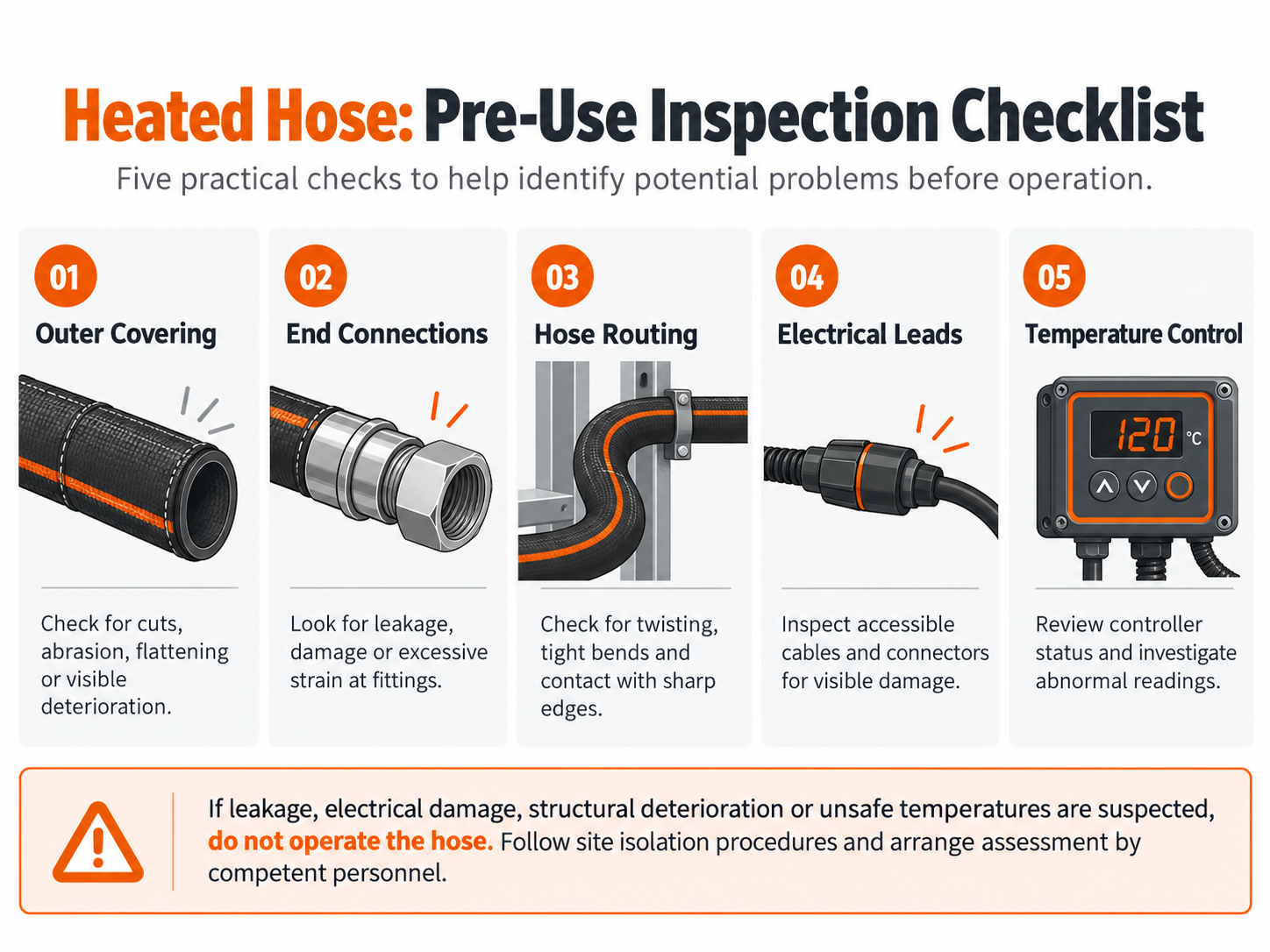
How to prevent it: Route hoses away from sharp edges, moving components and potential impact points. Use suitable protective sleeving or supports where required, and inspect the outer covering for abrasion, cuts, flattening or other visible damage.
5. Excessive Temperatures and Poor Temperature Control
Maintaining a stable operating temperature is essential for the safe and efficient performance of an electrically heated hose.
Operating above the assembly’s specified temperature limits can accelerate deterioration of the internal core, insulation, seals and electrical components.
Temperature control problems may result from incorrect controller settings, unsuitable sensor configurations or faults that prevent the heating system from regulating temperatures correctly.
It’s also important to consider the temperature of the material entering the hose. A process fluid that is already hotter than the assembly’s permissible operating temperature can cause damage even when the electrical heating system is functioning correctly.
How to prevent it: Verify that the hose and its temperature sensors and controllers are compatible with the intended application. Follow the manufacturer’s operating limits and investigate unexpected temperature increases, unusual controller readings or repeated overheating faults.
6. Incorrect Pressure Ratings or Chemical Compatibility
A heated hose must be suitable for both the material being transferred and the operating pressure of the process.
Different hose core materials offer varying levels of chemical resistance, temperature tolerance and pressure capability. Using an unsuitable material can lead to deterioration, contamination or damage to the internal fluid transfer path.
Pressure is equally important. Operating above the assembly’s rated working pressure, including during pressure surges, can place excessive stress on the core, reinforcement and end connections.
Operating temperature can also affect pressure capability, so the suitability of a hose should be assessed against the combined demands of the application rather than individual specifications in isolation.
How to prevent it: Confirm the process material, chemical compatibility, working pressure, expected pressure fluctuations and operating temperature before specifying or replacing a hose. Review the complete assembly rating, including its end fittings.
7. Moisture Ingress and Electrical Connection Damage
Electrically heated hoses contain components that may be vulnerable to moisture exposure or mechanical damage if their protective arrangements become compromised.
Damaged outer coverings, seals, end caps or electrical connections can create opportunities for moisture to reach sensitive parts of the assembly, depending on its construction.
Electrical leads and sensor wiring may also become damaged through pulling, repeated movement, abrasion or poor cable management.
Problems affecting the heating circuit or temperature sensor can lead to unreliable heating, incorrect readings or electrical faults.
How to prevent it: Inspect electrical connections, cable routing and protective coverings as part of routine maintenance. Ensure the hose is suitable for the environmental conditions and avoid exposing connections to moisture or chemicals beyond their specified protection ratings. Electrical testing and repairs should only be undertaken by appropriately qualified personnel.
Warning Signs That a Heated Hose May Be Failing
Not every heated hose problem results in an immediate or complete failure. Some faults develop gradually, giving maintenance teams an opportunity to identify potential issues before they interrupt production.
Common warning signs include:
- Uneven or Unstable Heating: Unexplained temperature fluctuations or sections that fail to reach their intended temperature.
- Visible External Damage: Cuts, abrasion, crushed areas or deterioration of the protective outer sleeve.
- Changes in Flexibility: Unusual stiffness, kinking or deformation compared with the hose’s normal condition.
- Leakage Around Connections: Signs of fluid escaping from fittings or the hose assembly.
- Electrical or Sensor Faults: Repeated controller alarms, unexpected readings or interruptions to electrical heating.
- Signs of Overheating: Discolouration, damaged insulation or unusual odours that may indicate excessive temperatures.
These symptoms do not always mean the hose itself has failed. Temperature instability, for example, can also result from problems elsewhere in the heating or control system. Our guide to cold spots in industrial fluid transfer systems explores some of the other factors that can affect temperature consistency.
However, any suspected damage should be investigated before the equipment continues operating.
How to Reduce the Risk of Premature Heated Hose Failure
A suitable maintenance programme can help identify problems early and improve the reliability of industrial heated hose installations.
The most useful preventative measures include checking that the assembly remains within its rated operating conditions, inspecting exposed components for damage and ensuring the installation allows appropriate movement without excessive bending or twisting.
Particular attention should be given to hose connections, areas exposed to abrasion, temperature-control equipment and any sections that experience frequent mechanical movement.
Maintenance intervals should reflect the demands of the application rather than relying on a single inspection schedule for every installation.
Where the same type of failure occurs repeatedly, it may indicate an underlying installation or specification problem that needs to be addressed before a replacement assembly is fitted.
When Should a Damaged Heated Hose Be Replaced?
The decision to repair or replace an industrial heated hose depends on the extent and location of the damage, the assembly’s construction and the operating conditions.
Minor damage to certain external components may be repairable following a suitable manufacturer assessment. However, damage affecting the pressure-containing core, reinforcement, heating circuit or critical connections may require complete replacement.
A hose showing signs of leakage, electrical failure or structural damage should be taken out of service and assessed by competent personnel. Before inspection or disconnection, the equipment must be safely isolated, depressurised and allowed to cool in accordance with the relevant procedures.
Repeated failures may also justify reviewing the hose specification, routing and operating environment to establish whether a different design would be more suitable.
Frequently Asked Questions About Heated Hose Failure
How long should an industrial heated hose last?
There is no universal lifespan for an industrial heated hose. Service life depends on its construction, operating temperature, pressure, frequency of movement, environmental conditions and maintenance. A correctly specified hose in a relatively stable installation may experience less wear than one exposed to continuous flexing or demanding operating conditions.
Can excessive bending permanently damage a heated hose?
Yes. Bending a hose beyond its specified minimum radius can damage internal components, even if the exterior initially appears unaffected. Repeated excessive bending may weaken reinforcement, heating elements or the hose core. Assemblies suspected of having been overbent should be assessed before further use.
Can a heated hose stop heating without leaking?
Yes. A heated hose may develop a fault within its heating circuit, temperature sensor or electrical connections while the internal fluid transfer path remains intact. This can result in insufficient heating, inconsistent temperatures or controller errors. Electrical faults should be investigated by qualified personnel rather than assuming the entire assembly has failed.
Can a damaged heated hose be repaired?
Some faults affecting replaceable external components or connections may be repairable, depending on the manufacturer’s assessment. Damage involving the hose core, reinforcement or embedded heating elements can be more difficult to address safely. A professional inspection is important before deciding whether repair or replacement is appropriate.
How often should heated hoses be inspected?
Inspection frequency should depend on the operating environment, application risk and manufacturer’s recommendations. Hoses exposed to frequent movement, high temperatures, vibration or mechanical contact may require more regular checks. Visual inspection before use, supported by planned maintenance and appropriate technical testing, can help identify developing problems.
What information is useful when replacing a failed heated hose?
Useful details include the hose’s length, internal diameter, operating temperature, pressure rating, electrical supply, temperature sensor type and connection fittings. Information about the material being transferred and the circumstances of the original failure can also help identify whether changes to the replacement specification are necessary.
Need Advice About a Heated Hose Problem?
Repeated hose failures can indicate a problem with installation, operating conditions or the suitability of the existing assembly.
Flexible Heated Hoses designs and manufactures bespoke industrial heated hoses for a range of demanding fluid transfer applications. Our team can review your requirements and discuss suitable replacement assemblies where necessary.
Contact us to discuss your existing hose, operating conditions or replacement requirements.